⚡ SPRINGFIELD EMERGENCY HEATING RESTORATION DESK
Furnace Running Constantly But Pushing Chilly Air Across Springfield?
Rapid Combustion, Flame Rectification & Draft Pressure Testing Across Clark County
⚡ 45-75 Min Clark County Arrival • Certified Microamp Testing • Zero High-Pressure Upsells
Why Your Furnace Blows Cold Air During Springfield Winter Freezes
When Arctic air plunges across west-central Ohio and settles into the Mad River and Buck Creek valley basin, temperatures drop swiftly across Springfield. Sub-zero cold air drains into low-lying river plains, creating deep thermal inversion pockets that chill uninsulated sandstone and rubble foundations across historic Victorian and Queen Anne homes in the South Fountain Historic District, Ridgewood, and Highlands. In post-war bungalows and suburban ranches throughout Northridge and East Springfield, older duct networks battle continuous drafts and freezing floor cavities over unconditioned crawlspaces. During severe winter freezes, residential forced-air furnaces operate under demanding duty cycles. When your supply grilles blow room-temperature or cold air while the furnace blower motor runs constantly, an integrated safety sensor has detected an operational fault and shut down the gas burners to prevent overheating or incomplete combustion.
You do not need a commissioned salesperson pushing an unneeded furnace replacement when a dirty flame rectification sensor, a frozen condensate drain trap, or an open limit switch is the true issue. You need an honest local technician specializing in furnace repair in Springfield who connects digital manometers, measures flame rectification in microamps, and tests electrical safety circuits. Our emergency mobile heating teams operate across Clark County 24 hours a day, 7 days a week.
Primary Combustion & Electrical Failures Behind Cold Supply Air
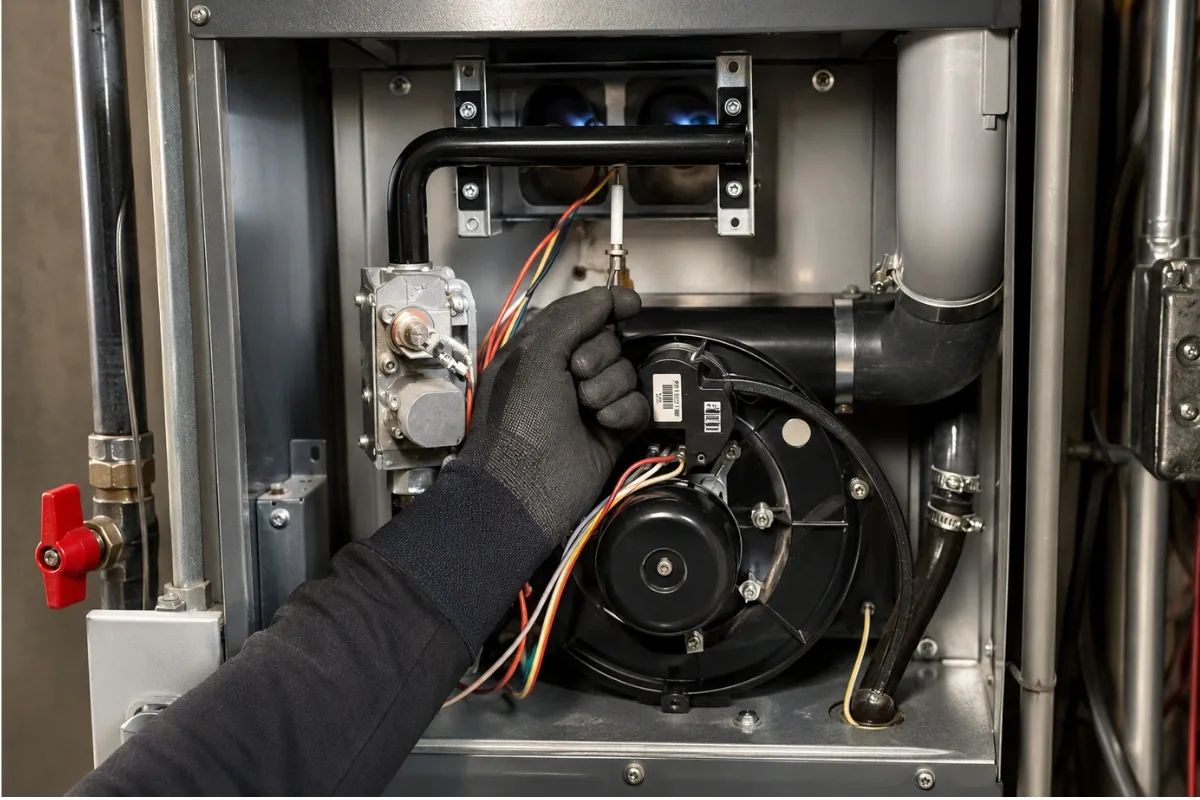
When the indoor blower fan runs without active combustion, certified technicians systematically evaluate four distinct points of mechanical and electronic failure:
- Flame Rectification Rod Microamp Current Drop: The flame sensor monitors combustion via a delicate DC microamp signal passing through the ionized gas flame to the burner chassis. In damp winter basements near the Mad River and Buck Creek, mineral oxidation and carbon deposits form an insulating layer over the metal rod. When the signal drops below 1.0 microamp DC, the integrated ignition module cuts the 24V supply to the gas valve within 4 seconds of ignition to prevent raw gas accumulation.
- Condensing Secondary Heat Exchanger Trap Freezing: High-efficiency (90%+ AFUE) condensing furnaces produce acidic moisture during fuel burn. In unconditioned basements, exterior utility rooms, or crawlspaces throughout Springfield, sub-zero drafts freeze external PVC drain tubing or internal P-traps. Backed-up water fills the draft inducer blower housing, preventing the differential pressure switch from confirming an exhaust draft (typically requiring -0.65″ W.C.), completely locking out the burners.
- Primary High-Limit Switch Bimetallic Warping: When a dirty return air filter or restricted sheet metal ductwork chokes airflow across the furnace heat exchanger, internal temperatures exceed safe operating limits (often 165°F to 200°F). Repeated thermal expansion cycles fatigue the internal bimetallic switch contacts, leaving the limit switch permanently open. The control board initiates an overheat safety sequence, locking out the gas burners while keeping the blower motor running continuously.
- Hot Surface Igniter (HSI) Electrical Resistance Drift: Modern silicon nitride and silicon carbide igniters require a precise electrical resistance range (typically 45 to 75 ohms). Thermal shock from continuous sub-zero heating cycles causes hairline micro-cracks across the element. The igniter may still draw voltage, but it cannot reach the 2,400°F threshold required to ignite natural gas from the Columbia Gas of Ohio manifold.
⚠️ CARBON MONOXIDE RISK: Never Repeatedly Reset a Locked-Out Furnace!
If your furnace is blowing cold air and repeatedly shutting off, do not keep flipping the power switch or breaker to force ignition!
Forcing repeated ignition cycles on a restricted combustion chamber can cause delayed ignition rollouts or accelerate thermal fractures in an aging heat exchanger. Hairline heat exchanger cracks allow dangerous, odorless carbon monoxide (CO) to leak into indoor supply ductwork. Turn the thermostat to “OFF” and have a certified technician inspect the heat exchanger before operating the system again.
Clear Diagnostic Standards & Upfront Component Pricing
Heating emergencies during sub-zero Ohio weather require fast dispatch with upfront pricing transparency. Our service protocol ensures clarity before any work begins:
- Complete Heating Diagnostic Assessment: Standard on-site testing across Springfield homes ranges between $79 and $119, covering draft pressure differential tests, flame microamp readings, and gas manifold pressure measurements.
- Guaranteed Flat-Rate Component Quotes: Whether your repair requires cleaning and testing the flame rectification circuit, thawing a frozen condensate line, or installing an OEM hot surface igniter, you receive a firm, all-inclusive quote before replacement starts.
- Zero After-Hours Surcharges: We maintain the same clear flat-rate pricing regardless of whether your heating system fails on a holiday evening or during a weekend freeze.
Primary Springfield Postal Delivery Zones Served
Our mobile heating units operate continuously across these primary local postal zones:
- 45502 (West Springfield / Rockway, Enon Road & Mad River Rural Corridor)
- 45503 (North & East Springfield / Northridge, Moorefield & Urbana Rd Area)
- 45504 (Central & South Springfield / Wittenberg University, South Fountain & Downtown)
Complete 24/7 HVAC Solutions in Springfield, OH:
- Emergency Furnace Repair Near Me in Springfield, OH | 24/7 Heating Fix
- Emergency AC Repair Near Me in Springfield, OH | Not Cooling
- HVAC System Replacement in Springfield, OH | New AC & Furnace
- HVAC Not Turning On & No Air in Springfield, OH? 24/7 Fix
- AC Unit Humming But Fan Not Spinning in Springfield, OH? 24/7 Fix
- AC Leaking Water Inside House in Springfield, OH? 24/7 Fix
- Heat Pump Not Heating or Cooling in Springfield, OH? 24/7 Fix
Restore Warmth to Your Springfield Home Right Now
Speak directly with a licensed furnace diagnostic specialist patrolling Clark County for fast same-day dispatch.
Frequently Asked Questions: Furnace Blowing Cold Air in Springfield
Why does my furnace blow warm air for two minutes and then turn cold?
This behavior is a classic indication of an open primary high-limit switch. The furnace ignites and produces heat, but restricted airflow (caused by a heavily loaded 1-inch pleated filter or closed supply registers) causes internal heat exchanger temperatures to spike. The safety switch cuts the gas burners to prevent damage while keeping the blower fan running to dissipate heat.
How does the Mad River valley freeze affect high-efficiency furnaces?
Condensing furnaces produce acidic water during normal operation. In low-elevation river hollows where sub-freezing air pools, uninsulated PVC drain terminations extending through rim joists freeze solid. This backs up water into the draft inducer housing, tripping the pressure differential switch and preventing burner ignition.
How quickly can an emergency technician arrive in Springfield?
Because our service vehicles patrol major thoroughfares including Route 40, Route 68, Route 72, and the I-70 corridor, our average arrival window is between 45 and 75 minutes from dispatch confirmation.